
Project title:
Valorisation and integration of extractive waste towards the sustainability of raw materials industry
Acronim: VALORWASTE
The project is funded by UEFISCDI – Program 5.8. – European and International Cooperation, Subprogramme Name: Subprogramme 5.8.1. – Horizon Europe Project Type: ERANET
Contract no: 6 / 2024
Topic: Supply of raw materials from exploration to mining
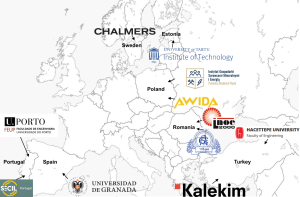
Participating institutions:
- University of Porto, Faculty of Engineering, Mining Engineering Department, Porto, Portugal- Coordinator
- Bucharest University of Economic Studies Economic Informatics and Cybernetics, Bucharest, Romania
- National Institute of Research and Development for Optoelectronics INOE 2000 Research Institute for Analytical Instrumentation, Cluj-Napoca, Romania
- Hacettepe University, Civil Engineering Department, Ankara, Turkey
- Chalmers University of Technology, Faculty of Chemistry and Chemical Engineering, Gothenburg, Sweden
- University of Granada, Granada, Spain
- University of Tartu, Institute of Technology, Tartu, Estonia
- Kalekim Construction Chemicals, Istanbul, Turkey
- AWIDA Sp.z.o.o., Olawa, Poland
- Mineral and Energy Economy Research Institute Polish Academy of Science Circular Economy, Krakow, Poland
- Secil – Companhia geral de cal e cimento, SA CDAC – Cement Applications Development Centre of SECIL group, Setubal, Portugal
- Limak Cement Company R&D Center, Ankara, Turkey
Abstract
The extractive industry has been considered one of Europe’s most significant waste streams. Given the ambition to move towards a circular economy, extractive wastes have the potential to be altered from a substantial environmental burden to valuable resources via the recovery of valuable minerals and critical raw materials (CRM), reprocessing, and reusing in various applications. Motivated by this, ValorWaste project was conceptualized to provide a holistic view under the reprocessing of extractive waste by addressing the following challenges: i) implement a comprehensive waste materials characterisation methodology to predict suitable valorisation routes; ii) assess the potential of sustainable mineral processing and hydrometallurgy techniques to valorise residues and recover CRMs and other strategic critical elements; iii) design construction materials and chemicals that can integrate extractive waste in their composition; iv) identify the environmental impact of developed valorisation routes using life cycle assessment, hot spot analysis and risk identification; v) provide access for ML algorithms, simulation models and analytics to support process/products optimisation and promote data-driven decisions; vi) identify business opportunities and challenges for the valorisation and integration of extractive waste in the materials construction industry; vii) promote sustainable practices and circularity for the raw materials industry. The project consortium is composed of 8 partners from University/Research Centres and four industrial partners, who have been selected based on their complementary expertise in terms of detailed technical competence in waste management and characterisation (INOE, UTARTU, AWIDA), mineral processing and hydrometallurgy (CUT, FEUP, HCT), construction materials and chemicals (UGR, HCT, SECIL, LIMAK and KALE), life cycle and impact assessment (MEERI PAS, UTARTU), data management and analytics (ASE, FEUP).
Project objective
The main objective of ValorWaste project is to contribute to the raw materials industry’s sustainability by proposing an innovative supply chain approach for critical and strategic raw materials towards the valorisation of residues generated by the extractive industry and its integration into construction materials and chemicals after recovery of the contained critical minerals.
Estimated results
- Questionnaire for the assessment of extractive waste
- List of extractive waste selected for valorization
- Preliminary characterization report of the extractive waste proposed for valorization
- Project web page
- Characterization report of extractive waste proposed for valorization
- Testing report for extractants used for the solubilization of valuable elements from extractive waste
- Paper presented at international conference
- Experimental report on the solubilization of valuable elements from extractive waste
- Report on valorization routes of extractive waste
- Paper presented at an international conference
- Manuscript submitted for publication
- Leaflet on mining waste valorization
Project start date: 01/04/2024
Project end date: 31/03/2027
Project duration: 36 months
Project team:
- CS I Dr. Levei Erika – team leader
- CS I Dr. Cadar Oana – team member
- CS III Dr. Scurtu Daniela – team member
- CS I Dr. Simedru Dorina – team member
- CS I Dr. Roman Cecilia – team member
- IDT III Varaticeanu Cerasel – team member
- CS II Dr. Torok Iulia – team member
- CS Dr. Angyus Bogdan – team member
- CS Dr. Eniko Kovacs – team member
Contact
Proiect Manager
CS I Dr. Erika Levei
Str. Donath nr. 67, Cluj-Napoca, Romania
E-mail: erika.levei@icia.ro; icia@icia.ro
Tel/Fax: +40 264 420590 / +40 264 420667
STAGE 1 (2024)
Stage 1. Identification and preliminary characterization of mining waste with valorisation potential
A1.1 Identification of mining waste with valorisation potential
A1.2 Selection of mining waste for valorisation
A1.3 Intercomparison of analytical methodologies used for mining waste samples characterization
A1.4 Preliminary characterization of the selected mining waste for valorisation
A1.5 Participation at the consortium meetings
RESULTS
- Questionnaire for the evaluation of the potential waste materials
- List of the selected mining waste types suitable for valorisation
- Report on the intercomparison of analytical methodologies used for the characterisation of mining waste samples
- Preliminary report on the characterisation of mining waste proposed for valorisation
- Consortium agreement signed by all the project partners
- Meeting minutes
- Project website
Stage 1 focuses on the identification, selection, sampling and preliminary characterization of mining wastes and overburdens generated by the extractive industries in order to identify those suitable as study cases for valorisation and for the development of construction materials and chemicals after the recovery of valuable minerals.
Under WP1, for the identification of different wastes with valorisation potential following the recovery of critical and strategic elements, a site questionnaire was developed and distributed to partners. This questionnaire gathered information regarding the location of the waste, name of the site, type and status of the operation, type of the waste, volume and heterogeneity of the available stock, history of the exploitation and treatment, particle size distribution, composition of the waste, the associated potential environmental impacts, and relevant links to other sources of information. Additionally, in order to identify the properties required for the waste to be used in construction materials, a waste questionnaire was filled out by the partners. This questionnaire requested information on the physical characteristics, chemical composition, minimum amount of waste, mineralogical characteristics, maximum cost of the material, maximum level of toxic elements/radioactive content, and useful links to information on the possible application of the waste.
Based on the information provided in the questionnaires, 14 types of waste suitable for utilisation in the construction materials industry after the recovery of critical and strategic minerals have been identified. These include granite sludge, marble sludge, limestone sludge, sulphide tailings, sand shape waste or byproduct, clay overburden, waste mixture, sand gravel, waste mixture and secondary products, clean sand, gneiss, low grade colemanite middlings, coarse size overburden of copper and iron ore, and fine size copper flotation tailings.
Of the 14 waste types identified, 6 were selected to be characterised and used as study cases for the development of valorisation methods, namely granite sludge, sulphide tailings, clay overburden, sand gravel, low grade colemanite middlings, and fine size copper flotation tailings. Representative samples were prepared and sent to the project partners involved in the characterization and intercomparison activities.
Based on the matrix of equipment available at the ValorWaste consortium partners, the following have been selected for the intercomparison exercise: (1) the determination of the concentration of major metals (Ca, Mg, Fe, Al) by mineralisation with aqua regia and the determination by inductively coupled plasma optical emission spectrometry; (2) the determination of trace metals concentration (Cr, Co, Ni, Cu, Zn, Pb, Y, La, Ce, Pr, Nd) by mineralization with aqua regia and the determination by inductively coupled plasma mass spectrometry; (3) the determination of oxide concentration by X-ray fluorescence. A comparison of the analytical methods was conducted on samples PL1 (clay overburden) and PL2 (sand gravel). The analytical methods employed by the research partners were found to be appropriate and resulted in reproducible results.
Of the wastes selected for valorisation, samples PL1, PL2 and PT1 were analysed at INOE using the following techniques: XRF, ICP-OES, ICP-MS, XRD, SEM, ICP, IC.
STAGE 2 (2025)
Stage 2. Physico-chemical characterization of selected extractive waste and identification of solubilization methods for the valuable elements
A2.1. Physico-chemical characterization of the extractive waste streams selected for valorization
A2.2. Identification of target elements for solubilization via hydrometallurgical techniques
A2.3. Testing of extractants for the solubilization of valuable elements from extractive waste
A2.4. Results dissemination and participation in consortium meetings
RESULTS
- Report on the physico-chemical characterization of extractive wastes proposed for valorization
- List of elements that can be solubilized using hydrometallurgical processes
- Testing report on selected extractants for the solubilization of valuable elements from extractive waste
- 4 presentations at international conferences
- 1 article published in a Web of Science–indexed journal
- 3 social media posts (LinkedIn)
- Updated project webpage
Stage 2 continued the physico-chemical characterization of the extractive wastes selected as case studies: clay overburden (Poland), sandy gravel (Poland), sulfide-rich tailings from the flotation circuit of a processing plant (Portugal), fresh granite sludge (Portugal), fresh marble sludge (Portugal), and fresh limestone sludge (Portugal). Based on their physico-chemical composition, the clay overburden and sandy gravel were found to contain SiO₂ as the major component (>80 %), followed by Al₂O₃ (≈10 %), while the concentrations of valuable elements were very low. Thus, these wastes can be valorized as construction materials, with no potential for prior recovery of valuable elements. In the sulfide-rich tailings, high concentrations of Cu (3300 mg/kg) and Zn (8700 mg/kg) were identified, suggesting that these metals could be recovered through hydrometallurgical processes. The fresh granite sludge, fresh marble sludge, and fresh limestone sludge are rich in Ca, Fe, and Si, and can be valorized in the construction materials industry without prior extraction of valuable elements. For the recovery of Cu and Zn from the sulfide-rich tailings, several leaching agents were tested, including mineral acids (HCl, HNO₃), an organic acid (acetic acid), and EDTA. The results showed that both HCl and HNO₃ solubilize up to 80% of Cu and Zn, but they also mobilize toxic elements such as As, Cd, Ni, and Pb. Acetic acid is more environmentally friendly, but achieves lower solubilization efficiencies (<50 %) for both elements. In 2025, the team participated in the annual project meeting organized by the Mineral and Energy Economy Research Institute of the Polish Academy of Sciences – Circular Economy, held in Krakow, Poland (29–30 May 2025). The team also attended the semestrial meeting of the consortium (3rd General Assembly), organized virtually on 22 October 2025. In addition to these events, several virtual working meetings took place within the different work packages.